
the receiving audit trail your food dc labor crew has to produce

When a truck backs into the dock at a food distribution center, the receiving audit trail your food DC labor crew has to produce starts before the first pallet moves: signed bills of lading, temperature logs, damage notes, and a count that matches the purchase order. Skilled Warehouse Labor makes that paperwork as tight as the unload itself.
By Humano Team, Logistics & Lumper Specialists
What Is a Receiving Audit Trail at a Food Distribution Center?
A receiving audit trail is the paper and digital record that proves what came off a truck, when it arrived, what condition it was in, and who checked it in. At a food DC, that trail exists because a pallet's temperature, count, and condition at the dock door become evidence later, during a recall, a customer chargeback dispute, or a routine GFSI (Global Food Safety Initiative) audit. Every document the crew signs, every temperature log entry, every damage note becomes part of a chain of custody that traces the product from the truck to the warehouse floor.
Food DCs treat this differently than a general merchandise warehouse would. A missing signature on a dry goods shipment is an inconvenience. A missing temperature log on a refrigerated load is a food safety gap an inspector can flag on the spot.
Who Is Responsible for the Receiving Audit Trail, the Labor Crew or the DC?
Responsibility splits between the two. The DC sets the receiving SOP (standard operating procedure), the audit checklist, and the retention policy; the labor crew executes it at the dock, shipment by shipment. The crew that unloads, counts, and inspects the load creates the audit trail in real time. But the DC's receiving manager remains the accountable party to customers, suppliers, and regulators, which is usually why supervisors countersign or spot check crew paperwork before it's filed. A DC that leans on skilled Warehouse Labor for receiving gets crews who already understand this split and treat documentation as part of the unload, not an afterthought.
What Documents Make Up the Receiving Audit Trail Your Food DC Labor Crew Has to Produce?
Every dock team learns fast that the receiving audit trail your food DC labor crew has to produce is only as strong as its weakest document. A typical receiving packet includes:
- Bill of lading (BOL), signed and matched against the purchase order
- Temperature log, recorded at the trailer door for refrigerated or frozen product
- Count verification, case and pallet counts reconciled against what the supplier shipped
- Damage and shortage notes, with photos where the DC's SOP calls for them
- Supplier certificates, when required for the product category (organic, kosher, or country of origin claims)
- Receiving checklist sign-off, the crew member's and supervisor's initials confirming every step ran
Food DCs live and die by their audit trails, because a single missing piece can stall an entire pallet at the dock until someone tracks down the answer.
What Technology or Systems Capture the Receiving Audit Trail Today?
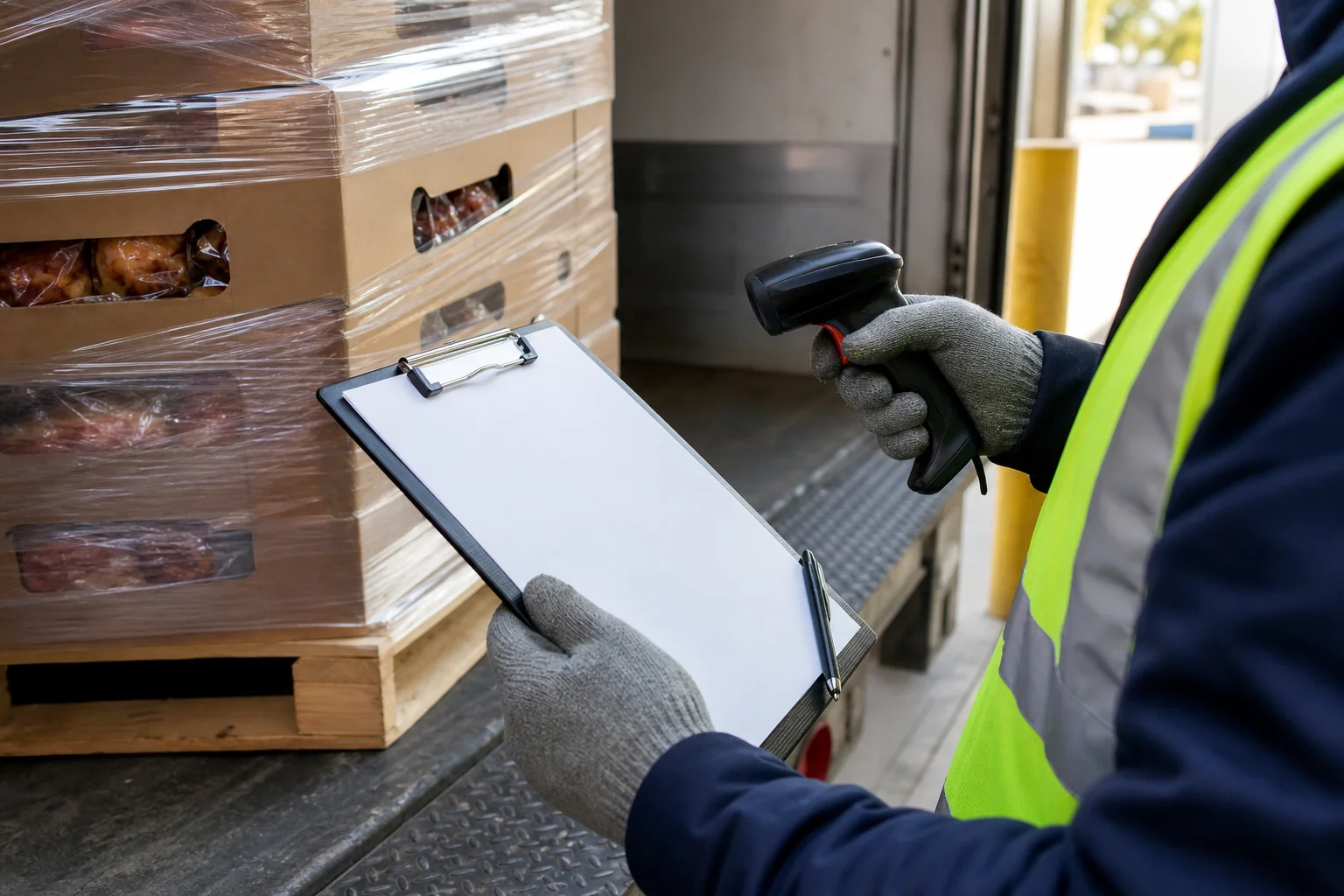
Most food DCs have moved past clipboard-only receiving. Handheld scanners tie a pallet's barcode directly to the purchase order in the warehouse management system (WMS), digital temperature probes timestamp a reading the moment it's taken, and photo capture on a tablet replaces a written damage description. That shift toward digital records is part of a broader move in warehouse technology adoption that is changing what a receiving crew is actually responsible for on the dock. Even with digital tools, the crew still has to run every check in the right order. Software records what happened; it does not decide whether the temperature reading was actually taken.
What Counts as Proof of a Compliant Receiving Audit Trail?
Proof means the record is complete, time-stamped, signed by whoever performed the check, and consistent with the physical inventory that landed on the floor. An auditor cross-references the WMS receiving record against the paper or digital checklist and the actual pallet count. If the numbers, times, and signatures line up without gaps, that packet is proof. If any one piece is missing or contradicts another, it isn't.
What Happens if the Receiving Audit Trail Is Incomplete or Missing?
When paperwork is missing, the receiving audit trail your food DC labor crew has to produce cannot be reconstructed after the fact, and that gap becomes the auditor's finding. The immediate consequences usually include a rejected or held load, a chargeback dispute the DC cannot win without proof of condition at receiving, and a broken traceability link if that product is ever part of a recall. Repeated gaps tend to trigger a corrective action plan from the DC's quality team, and in a third-party food safety audit (SQF, BRCGS, or a customer's own vendor audit), incomplete receiving records are one of the most common findings that drops a facility's score.
What Do Auditors Look For When They Review Receiving Records?
Auditors check for completeness first: every field filled in, every required signature present. Next they check consistency: does the temperature log's timestamp line up with when the trailer actually docked, does the count match what shipped, does the condition noted on the receiving report match any photos on file. Finally they look for how the DC handles exceptions. A shortage or a temperature excursion isn't automatically a failure; an unexplained one, with no corrective action documented, usually is.
How Long Do Food DCs Have to Keep Receiving Records, and Who Signs Off Once It's Complete?
Retention periods vary by product category, customer contract, and the specific food safety guidelines the DC operates under, so a crew should always follow the facility's written retention policy rather than assume a single universal number. Federal food traceability guidance generally points toward a minimum of two years for many records, and some customer contracts or certification programs require longer. Once the receiving packet is complete, sign off typically falls to the dock supervisor or the DC's receiving manager, who reviews the crew's documentation, confirms it matches the physical receipt, and countersigns before it's filed or entered into the WMS as final. The labor crew produces the record; the DC's management owns the final approval.
How Do Labor Crews Get Trained to Produce Accurate Receiving Documentation?
Getting the receiving audit trail your food DC labor crew has to produce right, every shift, comes down to training, not luck. Most food DCs run new crew members through a documentation walkthrough alongside the physical unload training: how to read a BOL, where to record a temperature reading, when a discrepancy needs a supervisor before the trailer leaves. Experienced Logistic Lumper Services crews build this into onboarding so a new hire isn't learning the paperwork for the first time during a live receiving check. Ongoing training usually includes shadowing a senior crew member for the first several shifts and a refresher any time the DC's SOP or its labor management software changes, since a new scanning step or a new required field is easy to miss without a walkthrough.
Does a Temp or Third-Party Labor Crew Need Special Training for Audit Paperwork?
Yes. A temp or third-party crew needs the same documentation training as direct-hire staff, ideally provided by the staffing partner before the first shift, not learned on the dock under pressure. That training should cover the DC's specific receiving checklist, basic food safety handling (temperature control, allergen awareness, product condition standards), and who to flag when something doesn't match. A staffing partner that skips this step is handing the DC a crew that can move product but can't produce a record an auditor will accept.
Frequently Asked Questions
Does the receiving audit trail apply to every delivery, or only temperature-sensitive product?
It applies to every delivery, though the specific documents differ. Dry goods still need a signed BOL, a count verification, and a condition check; refrigerated and frozen product add a temperature log at the dock door. The core principle, a documented record for everything that crosses the dock, stays the same across product types.
Can a receiving audit trail be fully digital, or does it still need paper signatures?
Many food DCs now run a fully digital receiving process, with scanners, digital temperature probes, and e-signatures replacing paper. Some customer contracts or certification bodies still require a wet signature on specific documents, so a crew should follow the facility's SOP rather than assume digital always replaces paper.
What's the difference between a receiving audit trail and a standard receiving report?
A receiving report usually just confirms what arrived and in what quantity. A receiving audit trail is broader: it's the full set of time-stamped, signed evidence, temperature logs, condition notes, and sign-offs, that proves how the receiving process was actually performed, not just what the final count was.
Who reviews the receiving audit trail on a day-to-day basis?
The dock supervisor typically does a same-shift review, checking for missing fields or unresolved discrepancies before the paperwork is filed. The DC's quality or compliance team then does a periodic review, often weekly or monthly, looking for patterns rather than single-shift issues.
Get a Receiving Crew That Documents Every Load Correctly
A DC's audit trail is only as reliable as the crew producing it shift after shift. Contact Humano to staff a receiving team trained to get the paperwork right the first time.