
container unloading cost per unit: per-container devanning vs hourly

Container unloading cost breaks down two ways: a flat per-container devanning rate or an hourly labor charge, and which one wins depends on load type, container size, and how fast the crew works. Humano's Container Unloaders price both models, so this guide walks through what actually drives your number.
By Humano Team, Logistics & Lumper Specialists
Most logistics providers price container unloading one of two ways: a flat rate per container, or an hourly rate for the crew and equipment on site. Neither approach produces one universal number, because a flat per-container devanning rate depends on how the shipping container was loaded and how much freight is inside, while an hourly rate depends on crew size and how long the job actually runs.
A per-container rate works like a fixed quote. You know the total cost before the truck backs into the dock, and the provider absorbs the risk if the unload takes longer than expected. An hourly rate shifts that risk to you. A fast, palletized load can finish well under the hours a flat quote would have priced in, so you pay less. A slow, floor-loaded container can run the other direction. Whether it is cheaper to pay per container or by the hour usually comes down to how predictable your freight mix is: steady, palletized volume tends to favor a flat rate, while irregular or mixed freight often favors hourly, since you are not paying a premium built into the flat quote to cover the provider's downside risk.
Logistic Lumper Services crews typically quote both structures once they know the container type, dock configuration, and expected freight mix, so a business is not locked into one pricing model across every shipment. The same per-container-versus-hourly tradeoff shows up on the loading side of the dock too, where container loading pricing follows a nearly identical logic: predictable, palletized freight favors a flat rate, while irregular freight favors hourly.
What Drives Container Unloading Cost Up or Down
A handful of factors move container unloading cost more than any others, and most of them are set before the crew ever arrives.
Container size. Standard container shipping runs on 20-foot, 40-foot, and 40-foot high-cube boxes, and container size sets the ceiling on labor time regardless of pricing method. A larger container generally takes proportionally longer to clear, though the relationship is not perfectly linear since a partly empty 40-foot box can move faster than a packed 20-foot one.
Freight configuration. Floor-loaded freight, cartons and goods stacked and wedged directly on the container floor, takes meaningfully longer to unload than palletized freight, since crews are hand-stacking cartons instead of pulling pallets with a jack or forklift. Freight configuration and packaging determine how fast a crew can clear a container, and a container built with mixed carton sizes and no pallet structure typically pushes cost toward the higher end of whatever range a provider quotes.
Access and dock conditions. A dock with tight staging space, no forklift access, or a container that has to be hand-bombed off a chassis in a parking lot adds time that a standard dock unload would not require.
Crew size and equipment. Larger crews finish faster but cost more per hour in aggregate, even if the per-container total comes out similar. Equipment such as pallet jacks, forklifts, or conveyor systems can shorten the job, but providers typically bill equipment as a separate line rather than folding it into a flat labor number.
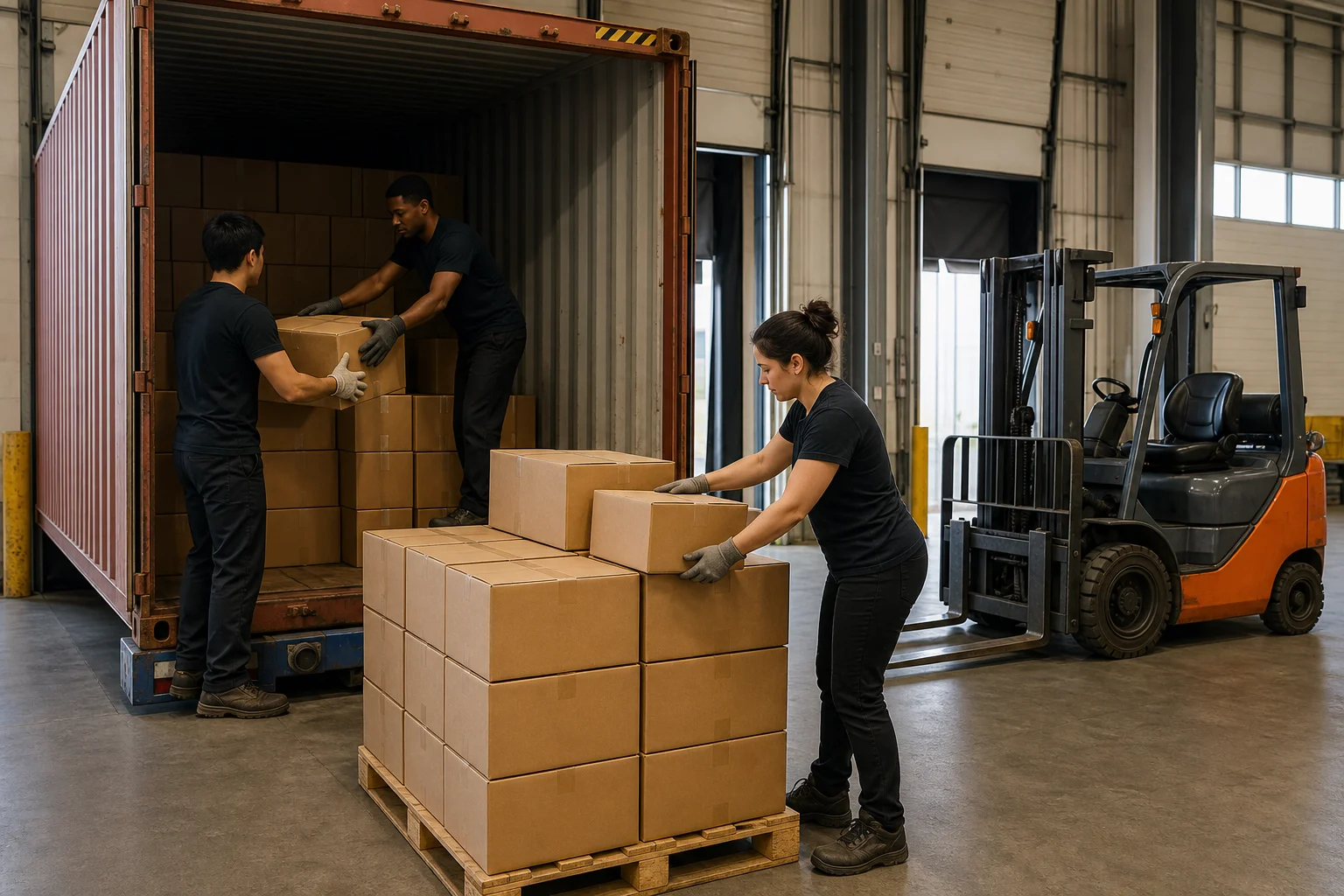
Devanning a Full Container vs a Partial Load
Devanning is the industry term for physically removing freight from inside a shipping container, and it is priced differently depending on how full that container is and how the freight was packed.
A full container, floor to ceiling, takes a predictable amount of labor because the crew works through a known volume start to finish. A partial load sounds like it should cost proportionally less, and it usually does on a per-hour basis, but a per-container flat rate does not always scale down the same way, since a provider still has to schedule a crew, a dock slot, and equipment regardless of how full the box is. Some providers quote partial loads at a reduced flat rate; others move partial loads to hourly billing specifically because the labor time is harder to estimate from container size alone.
The practical takeaway: devanning and general container unloading are close enough in scope that many providers use the terms interchangeably, but devanning specifically refers to full removal of contents, which matters when you are comparing a quote for a full container against a quote for a partial or mixed load.
When Hourly Rates Cost Less Than a Flat Per-Container Rate
Hourly labor tends to cost less than a flat per-container rate in a few specific situations. A well-organized, fully palletized load with clear dock access usually moves fast, and a crew billing hourly finishes that job in less time than a flat quote would have priced in to cover an average or worst-case load. A partial container, where there simply is not much freight to move, almost always costs less hourly than a flat rate sized for a full container.
Flat per-container rates tend to win when the freight mix is unpredictable, when floor-loading is common, or when a business wants budget certainty across many containers a month rather than a number that swings with how each individual load goes. A business running high volume with mostly palletized freight often does better locking in a flat rate across a contract; a business with occasional, unpredictable containers often does better paying hourly and avoiding a flat rate priced for a worst-case scenario it rarely hits.
Cost Per Pallet, Extra Fees, and How to Lower Your Unloading Costs
Cost Per Pallet or Per Unit
Once freight is off the container, some providers quote a per-pallet or per-unit rate instead of a per-container or hourly number, particularly for high-volume accounts that want a consistent line item across every shipment regardless of container size. A per-unit structure works best when freight arrives in standard units, cartons, boxes, or pallets of similar size, since a highly irregular mix makes a flat per-unit rate hard for a provider to hold to. For a warehouse comparing a dedicated crew against temp labor filled hour to hour, dedicated lumper crew pricing tends to hold steadier per unit than temp labor whose hourly cost swings with availability and overtime.
Extra Fees on Container Unloading Quotes
The base rate rarely covers everything. Common line items billed separately include detention or demurrage if the container sits at the dock past its free time, temporary storage if freight needs somewhere to store before its next leg, equipment rental for forklifts or pallet jacks the site does not already have, after-hours or weekend labor premiums, and sorting or re-palletizing fees when floor-loaded freight has to be built onto pallets as part of the unload rather than simply carried off. Ask any provider up front which of these are bundled into the base rate and which show up as separate line items, since a low headline number that excludes detention and storage is not actually the lower quote once the full bill arrives.
How to Lower Container Unloading Costs
A few moves consistently bring container unloading cost down: request palletized loading from the shipper whenever you control that step, since palletized freight unloads faster than floor-loaded cartons under either pricing model; schedule unloads during standard hours to avoid premium labor rates; keep dock staging spaces clear so crews are not waiting on space to place freight; and provide accurate container and freight details up front so the provider can quote a flat rate that matches the actual job instead of pricing in a buffer for the unknown, which makes it easy to compare quotes across providers.
Frequently Asked Questions
What is the average cost to unload a 40-foot container?
There is no single average, because cost depends on freight configuration, container size, dock access, and whether the provider bills flat or hourly. A palletized 40-foot container generally costs less to unload than a floor-loaded one of the same size, since the labor time differs substantially between the two. Ask a provider to quote your specific freight mix rather than relying on an industry average.
Is it cheaper to pay per container or by the hour for unloading?
It depends on your freight. Fast, palletized loads with good dock access tend to cost less on an hourly basis, while unpredictable or floor-loaded freight tends to cost less under a flat per-container rate, since that rate already accounts for the extra time. Businesses with consistent, high-volume freight often prefer the budget certainty of a flat rate regardless of which is technically cheaper on any single load.
What is the difference between devanning and container unloading?
Devanning specifically means removing all contents from inside a shipping container, while container unloading is the broader term for the process, including partial loads. Many providers use the terms interchangeably in everyday conversation, but a quote for full devanning should specify that the whole container is being cleared.
Does floor-loaded freight cost more to unload than palletized freight?
Generally, yes. Floor-loaded cartons and goods have to be hand-stacked and carried out individually, while palletized freight can be pulled with a jack or forklift in far less time. A container built primarily with floor-loaded freight typically pushes cost toward the higher end of a provider's quoted range.
What extra fees should I expect on a container unloading quote?
Ask about detention or demurrage charges if the container sits past its free time, equipment rental for forklifts or pallet jacks, after-hours labor premiums, and sorting or re-palletizing fees for floor-loaded freight. A quote that looks lower on its base rate can end up costing more once these separate line items are added.
Get an Accurate Container Unloading Cost Quote
The fastest way to know your real number is to hand a provider your container size, freight configuration, and dock conditions and let them quote both pricing structures side by side. Contact Humano to get a quote built around your actual freight, not an industry average.