
in-plant loading team vs outsourced warehouse labor: which one holds your outbound schedule
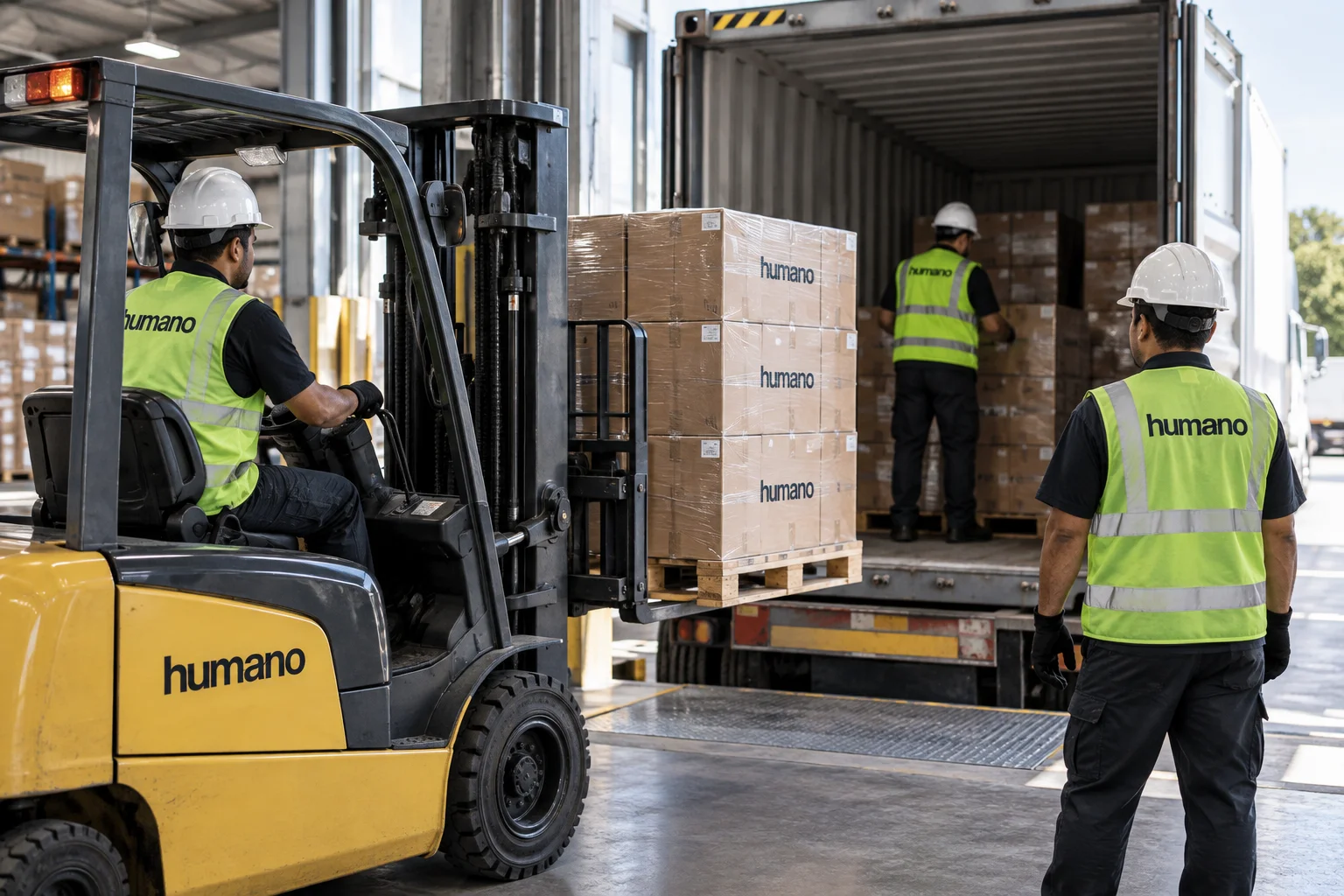
Outsourced warehouse labor usually holds an outbound schedule better than an in-plant loading team when volume swings, because the provider carries the staffing risk. An in-plant team wins when volume is flat. Here is how each model works, what drives cost, and when to switch, using humano's container loaders as the reference.
By humano Team, Logistics & Lumper Specialists
| Factor | In-plant loading team | Outsourced warehouse labor |
|---|---|---|
| Who employs the crew | You | The provider |
| How cost behaves | Payroll and benefits run whether trucks load or not | Can follow volume, as in humano's per-unit model |
| Volume swings | You hire, cross-train or pay overtime | The provider adds or trims crew under the agreement |
| Call-outs and turnover | Your supervisors absorb them | The provider replaces people, if the contract says so |
| Control of the dock | Direct | Shared, set by the agreement and reporting |
| Best fit | Flat, predictable outbound volume | Variable volume or growth |
What is outsourced warehouse labor and how does it work on a loading dock?
Outsourced warehouse labor means an outside provider supplies and manages the crew that loads your trailers and containers. Your team keeps planning, inventory control, order fulfillment and customer service. The provider's associates, the workers who do the physical loading, run the dock.
Logistics outsourcing is the wider idea. You hand part of your supply chain to a specialist so your core business gets your attention. Many third-party logistics providers, often called 3PLs, can run transport, warehousing and order fulfillment. Some operators go further and hand the whole building to providers that run full warehousing and fulfillment. Outsourced warehouse labor is narrower. You keep the building, the warehouse management system (WMS) and the inventory, plus your wider logistics and supply chain planning. You hand off only the loading crew.
How does warehouse labor outsourcing work for outbound shipping?
Warehouse labor outsourcing for outbound shipping starts with your forecast volumes: how many pallets, trailers or containers leave each week, and when. The provider builds a crew to that schedule, loads to your standards and reports output. Billing follows the agreement.
With humano, billing follows cost per unit (CPU). You pay per pallet loaded or per container loaded, not per labor hour, so the expense tracks output and idle time stays off your bill. humano handles recruiting for its own crews through bilingual recruiters, zip code analytics and job fairs, which keeps staffing the provider's job instead of yours. It prefers annual or dedicated agreements over short projects, because known volumes let a crew be planned ahead.
Outsourced vs in house: which holds your outbound schedule?
An in-plant team gives you direct control. You pick who to hire, how to train them and where they stand on the dock. Your schedule still depends on their attendance, though. When three loaders miss a shift, the trucks wait or your supervisors load them, and a late truck quickly becomes a customer service problem that ripples through fulfillment and the wider supply chain.
A contracted crew moves that risk. Coverage becomes the provider's obligation, and your warehouse operations stay on schedule if the agreement demands it. Scalability is one of the main advantages. Providers can add crew for peaks and trim it afterward, while an in-house team means new investments in hiring and training each time volumes climb. Specialist providers also concentrate their expertise on the dock, which is their whole business, and that expertise brings efficiencies a part-time in-house crew rarely matches. Those advantages matter most to teams that already juggle warehousing and logistics with lean staffing.
What happens to the outbound schedule when loaders call out or turnover spikes?
In-house, a call-out lands on your supervisors. They pull people off picks and other warehouse operations, approve overtime or push loads to the next day. A turnover spike is worse. Every new hire needs training before loading to your accuracy standard, and that time comes out of your throughput.
With the provider's crew, the provider replaces the person and absorbs the retraining. That only works if the agreement says so. Tie coverage to measurable dock labor SLA metrics, such as on-time load completion, so a missed shift has a defined consequence instead of a conversation.
How fast can an outsourced warehouse labor provider fill a loading crew?
No honest universal number exists. Speed depends on your market, your volume and whether an agreement is already in place. A provider that handles recruiting itself, as humano does, takes hiring off your plate instead of leaving you to staff the shift. Compare providers on logistics expertise as well as speed, and ask each for a written start plan with dates before you sign.
Who each option suits:
- An in-plant team suits sites with flat volume, a stable crew and supervisors who want hands-on control.
- Outsourced warehouse labor suits sites where volume swings, turnover is high or management time on the dock is short.
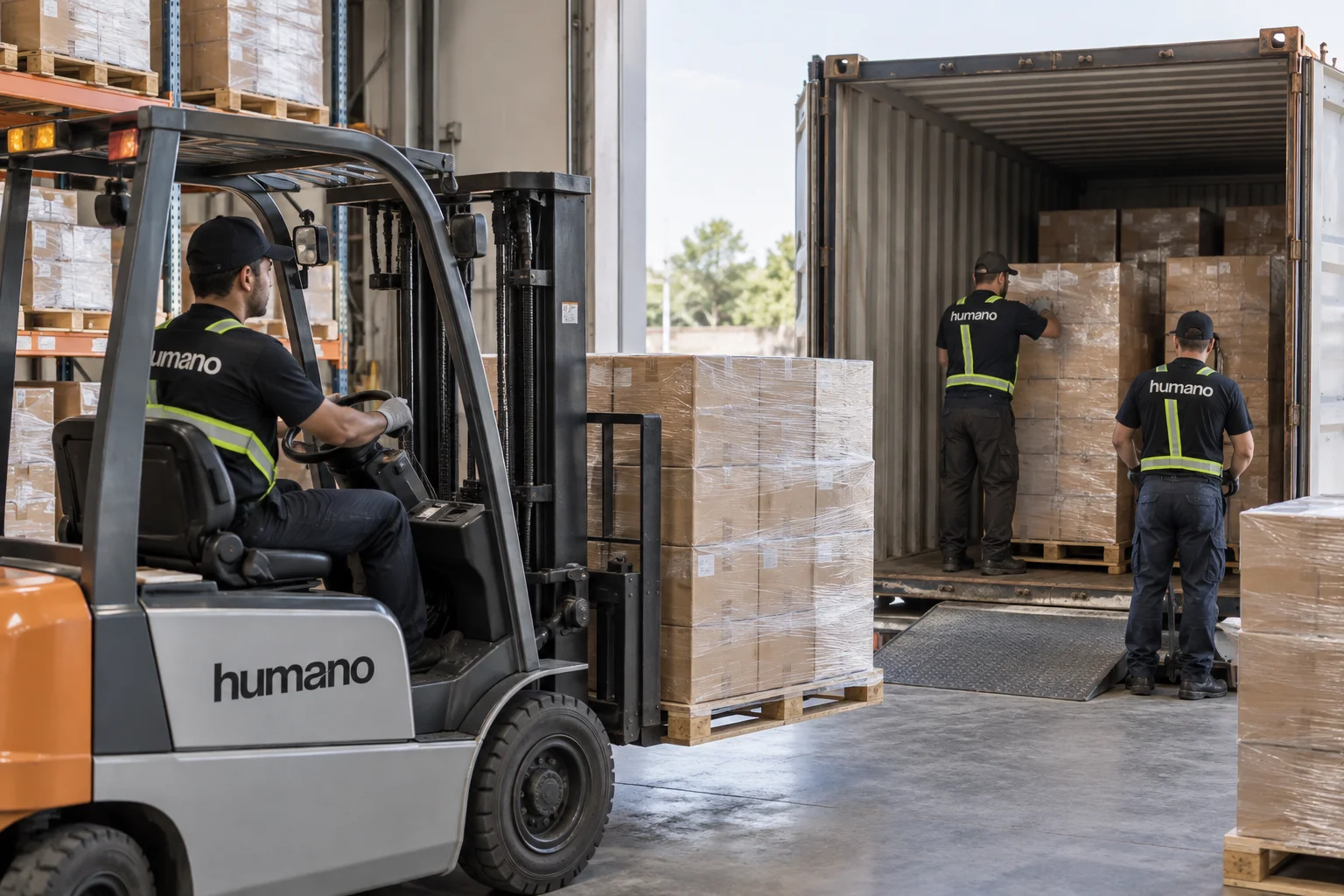
How much does outsourced warehouse labor cost compared to an in-plant loading team?
Cost has different drivers on each side. An in-plant team carries wages, payroll taxes, benefits, recruiting, training, supervision, equipment investments and the hours a loader stands idle. Most of that is a fixed expense. With outsourced warehouse labor, the provider's rate covers its own labor, management and margin. You do not set or pay worker wages directly, and in a per-unit contract the total moves with volume.
Under that model, container loading cost per unit rises and falls with what you actually ship, while an hourly crew costs the same on a slow Tuesday as on a peak Friday. Because humano bills per unit, budgeting is volume times rate, and the efficiencies show up as fewer paid idle hours. Those efficiencies hold even when volumes dip. If quotes from different providers are priced differently, convert both to the same unit before you compare them.
Is outsourced warehouse labor cheaper than hiring in-house loaders?
Sometimes. If your volumes are high and steady every day, an in-house team can capture real efficiencies because few hours go idle. If volume swings, in-house means paying for capacity on slow days or paying overtime on busy ones. Outsourcing tends to win there because you stop paying for idle time. Run the math with your own weekly volumes, not an average.
Who is responsible for safety and workers' comp with outsourced warehouse labor?
Providers usually employ the workers, so they carry workers' compensation for them. Safety is shared, though. OSHA guidance on temporary workers treats the host employer and the staffing agency as jointly responsible for a safe workplace. You control the dock, the forklifts and the layout, so you brief the crew on site hazards.
Put the rest in writing: certificates of insurance before the first shift, who supplies protective equipment, who trains crews on site equipment, and how incidents get reported. Terms vary by contract, so have your insurance broker or counsel review the wording.
When should you switch from an in-plant loading team to outsourced warehouse labor?
Use these rules by situation:
- Volume swings by season or customer: pick outsourced warehouse labor. Staffing in-house for the peaks leaves you paying for idle hours the rest of the year.
- Turnover on the dock stays high: go with a provider. The provider takes on recruiting and training.
- You add a new lane, port or customer: start with a provider, so you avoid new investments before volumes prove out.
- Volume is flat and your crew is stable: stay in-plant.
- Loaders also handle picks and packing inside your WMS workflow: keep that inventory-linked work in-house and outsource only the loading.
Flexibility and scalability are the common thread. If your loading needs change faster than your hiring can, switch.
Can you run a hybrid of an in-plant team and outsourced warehouse labor?
Yes. Keep a core in-plant team for baseline volume and daily warehouse operations such as inventory counts, and send peaks and container work to the provider. Define who owns which loads and how each crew's output and accuracy are measured, so accountability does not blur when two crews share one dock.
Our verdict: outsourced warehouse labor for variable outbound volume
The outsourced vs in house decision comes down to volume. If your outbound schedule slips when loaders call out, or you staff for the peak and pay for it all year, outsourced warehouse labor is the better choice. It moves the staffing risk, the idle time and the recruiting work to a provider whose expertise is the dock, spares you new investments in headcount, and lets your core business focus on selling and serving customers. Keep an in-plant team only where volume is steady and the crew is stable.
Tell humano about your outbound volumes and your current in-plant cost, and see how a per-unit model for warehouse labor compares. humano builds these as annual agreements, and smaller inquiries that fall short of that are still worth a conversation.
Talk through your outbound schedule with humano
Bring your hardest shifts and your weekly volumes to humano's contact team.