
fhi vs humano: two managed warehouse labor models compared for 3pl operators
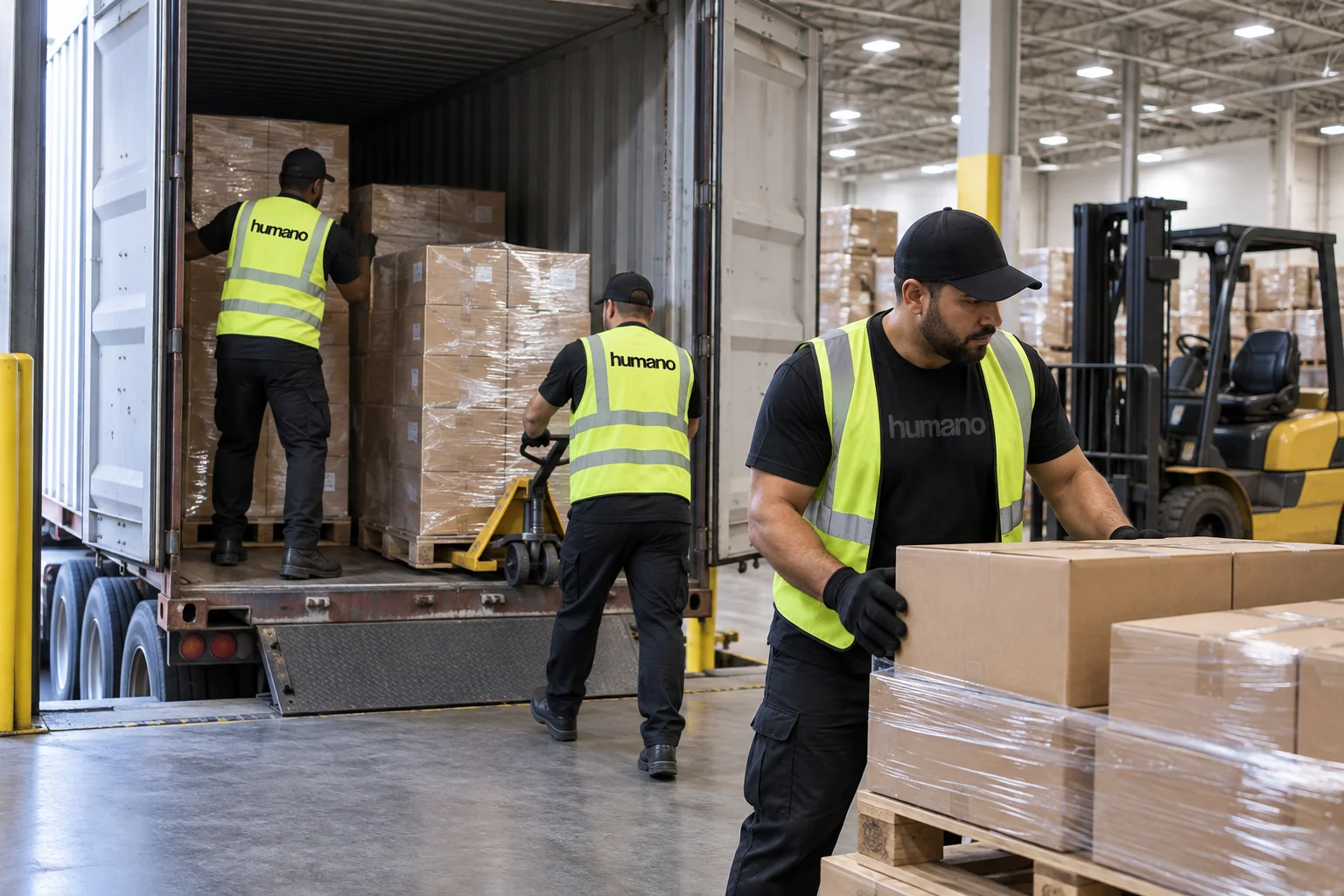
3PL operators comparing FHI vs. Humano for managed warehouse labor are weighing two different operating philosophies: a large, broad-market staffing name against a lumper-and-container specialist built around dedicated crews, direct on-site supervision, and Humano's container and lumper Services, which target dock throughput rather than general staffing coverage.
By Humano Team, Logistics & Lumper Specialists
Staffing Model and Crew Structure: FHI vs. Humano
A managed warehouse labor model means a 3PL hands off recruiting, scheduling, and on-site supervision of dock and warehouse crews to an outside partner, rather than carrying that headcount on its own payroll. FHI, as one of the larger names in warehouse and industrial staffing, generally operates as a broad-market labor provider, supplying crews across multiple industries beyond logistics. Humano's staffing model is built specifically around freight and distribution work: container loading and unloading, lumper crews for inbound trailers, and general warehouse labor, all managed with dedicated on-site leads rather than a rotating bench of general-assignment workers.
That structural difference, a broad-market staffing bench versus a logistics-only crew model, is the starting point for every other FHI vs. Humano comparison point below. A 3PL running high-volume container transloading or managing lumper crews for retail DC deliveries needs a partner whose crews already understand trailer sequencing, load patterns, and dock safety protocols on day one, not a generalist labor pool being trained on the job.
Pricing Models: What 3PL Operators Pay With FHI vs. Humano
Neither FHI nor Humano publishes a public rate card, and any managed labor provider quoting a flat per-hour or per-container price without seeing a facility's volume, shift pattern, and SLA requirements should be a caution flag rather than a selling point. What 3PL operators can and should compare is pricing structure: whether a provider bills per shift, per container, per pallet, or on a program basis that bundles supervision and reporting into one line item.
Humano prices its managed labor around the scope of the work itself, container loading and unloading, lumper support, or general warehouse labor, with supervision built into the program rather than billed as a separate line. That matters for budgeting because a lower hourly rate from a general staffing provider can still cost more once a 3PL adds its own supervisory overhead to manage that crew. The honest answer to how much Humano costs compared to FHI is that it depends on scope, shift length, and crew size at a specific facility, which is why a scoped quote, not a published rate, is the only number worth comparing.
Labor Quality and Crew Retention: Where the Two Providers Differ
Lumper crew retention is the metric that actually predicts labor quality on a dock, because a crew that turns over every few weeks never gets fast at the specific trailer configurations, product mix, and safety rules of one facility. Large, multi-industry staffing providers like FHI draw from a general labor pool that also fills warehouse, event, and light-industrial roles elsewhere, which can mean less crew consistency at any single site.
Humano's model keeps crews dedicated to logistics work and pairs them with a fixed onsite leadership structure, which makes crew throughput repeatable shift after shift, rather than rotating supervisors along with the labor pool. That consistency is what lets a 3PL hold a lumper crew or container team accountable to the same productivity standard week over week, instead of re-training a new group every time volume picks back up.

Scaling for Peak Season and Weekly Volume Surges
Seasonal peaks, holiday retail surges, produce season, or a sudden spike in inbound containers expose the real difference between a staffing bench and a managed crew model fast. A broad-market provider can usually flex headcount up by pulling from its general labor pool, but that often means a wave of unfamiliar workers hitting the dock right when volume and error tolerance are both at their worst.
Humano scales by adding trained lumper and container crews from within its existing logistics-focused workforce, which keeps the ratio of experienced workers to new hires higher during a surge. For a 3PL that scales up and down weekly rather than just seasonally, the harder problem is finding a weekly-scaling labor partner that doesn't reset crew quality every time the schedule changes, since a provider built for occasional seasonal spikes doesn't always hold up under a weekly cadence.
Technology and Reporting Tools for 3PL Operators
3PL operators need more than a headcount on the dock, they need visibility into what that crew is actually producing: units per hour, containers cleared per shift, and any exceptions that affect a customer's SLA. Reporting depth varies widely across the staffing industry, and a large multi-industry warehouse labor provider's dashboard is often built for general workforce management rather than logistics-specific metrics like dwell time or lumper turn count.
Humano's on-site supervisors track crew productivity and shift activity at the facility level and can surface that data back to a 3PL's operations team, so a warehouse manager isn't relying on a staffing rep's word for how a shift actually went. For 3PL operators comparing technology specifically, the more useful question isn't which company has more software, it's whether the reporting reflects logistics-specific numbers a dock manager already tracks: containers per shift, lumper turn time, and exception counts, not generic labor-hour totals.
Choosing the Better Fit for a 3PL Warehouse: FHI vs. Humano
For a 3PL evaluating FHI vs. Humano, the decision usually comes down to how specialized the operation's labor needs are. A distribution center with straightforward general warehouse labor needs and low seasonal variation may do fine with a broad-market staffing provider. A 3PL running container transloading, lumper programs for inbound retail freight, or any operation where dock throughput directly affects customer SLAs benefits more from a partner whose entire crew structure, training, and supervision are built around that exact work.
Operators evaluating their current labor spend against what a logistics-specialized model actually delivers can request a scope walkthrough of Humano's Warehouse Labor program to compare staffing levels, supervision ratios, and shift coverage against their existing provider.
Frequently Asked Questions
Is Humano more expensive than FHI?
Neither company publishes a public rate card, so a direct price comparison isn't possible without a scoped quote from each provider. Cost depends on the type of labor needed (container loading and unloading, lumper crews, or general warehouse labor), shift length, and crew size, and whether supervision and reporting are bundled into the price or billed separately. The more useful comparison is what's included at that price, not the number itself.
Can a 3PL switch from FHI to Humano without disrupting operations?
In most cases, yes, a transition can be scoped around existing shift schedules so crews are in place before the prior provider's coverage ends. A short overlap period, where both crews are briefly available, usually reduces the risk of a coverage gap during handoff. The exact transition plan depends on the facility's shift structure and current staffing levels, which is why it's typically mapped out during an initial site conversation rather than assumed upfront.
Do FHI and Humano serve the same industries and warehouse types?
FHI operates as a broader multi-industry staffing provider, while Humano's crews are built specifically for logistics and distribution work: container loading and unloading, lumper services for inbound trailers, and general warehouse labor. A 3PL, retail distribution center, or freight transload operation looking for crews trained specifically on dock and container work is closer to Humano's core focus than a general labor pool serving multiple industries.
What's the typical onboarding timeline when switching lumper crews?
Onboarding usually starts with a site walkthrough to confirm shift patterns, dock layout, and current headcount, followed by crew placement and a short supervised ramp-up period. Timelines vary by facility size and current staffing levels, so an exact start date is usually confirmed after that initial site visit rather than set in advance.
Get a Scoped Labor Quote for Your 3PL Warehouse
Comparing FHI vs. Humano only matters when the comparison is based on your facility's actual shift patterns and volume, not a general rate. Contact Humano's team to scope a managed labor plan for your warehouse.